
Endometriosis and CBD
Endometriosis affects around one in ten women of reproductive age, and a diagnosis still often takes the better part of a decade. Often they are told this is IBS or simple painful periods. When treatment arrives, it usually comes as hormonal suppression or surgery. Both help some women a great deal. But hormonal therapies are unsuitable for anyone trying to conceive, carry side effects that many find hard to live with, and do little for the large group whose pain persists after technically successful surgery. Endometriosis is when tissue similar to the lining of the womb grows outside the uterus and attaches to other organs, causing pain and bloating. It increasingly looks like a neuroimmune condition, with pain that often persists even after the lesions are removed.
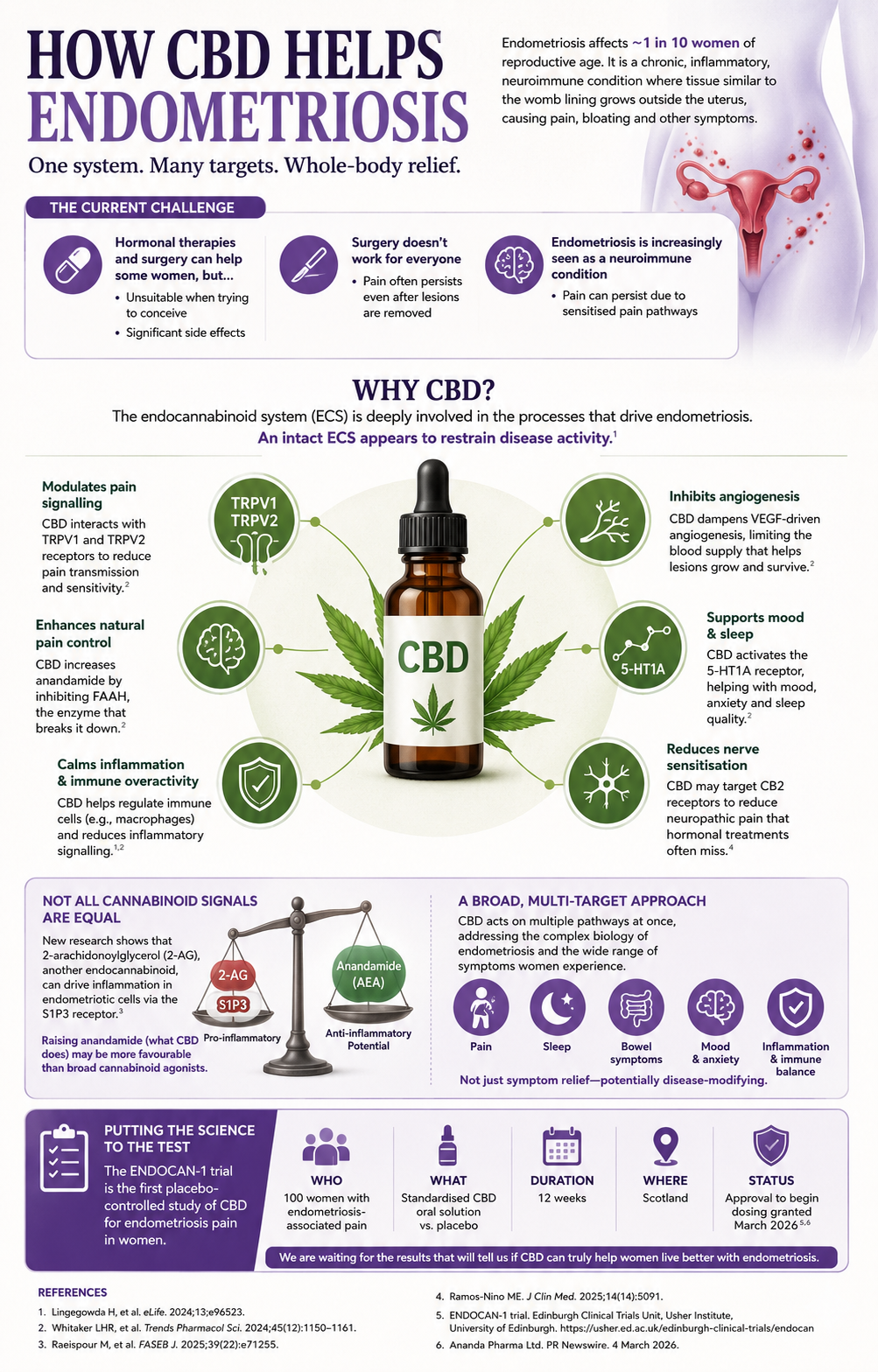
The interesting question is not simply whether cannabidiol helps, but why. The endocannabinoid system is involved in the physiological processes that drive the disease: inflammation, the growth of new blood vessels into lesions, immune surveillance, and the sensitisation of pain pathways.
The most striking recent evidence comes from Lingegowda and colleagues at Queen's University, writing in eLife in 2024. Using mice bred to lack the cannabinoid receptors CNR1 or CNR2, they found that removing CNR2 caused a near-total collapse of certain immune cells in the peritoneal fluid, but only in the setting of endometriosis. Knocking out either receptor left lesions larger, more vascularised, and more heavily infiltrated by macrophages. In other words, an intact endocannabinoid system appears to restrain disease activity. That is a different proposition from many conditions we treat with cannabinoids, where treatment eases symptoms without touching the root cause. Whether supplemental CBD can replicate this disease-restraining effect in patients, rather than simply easing symptoms, is exactly what still needs testing.
Whitaker, Horne and Saunders highlighted the breadth of action of CBD in Trends in Pharmacological Sciences in 2024, calling CBD a promising therapeutic agent precisely because it acts on so many targets at once. It engages TRPV1 and TRPV2 receptors and the serotonin receptor 5-HT1A, and it raises the body's own anandamide by inhibiting FAAH, the enzyme that breaks it down. It also dampens the VEGF-driven angiogenesis that lets lesions build a blood supply. That breadth offers a plausible reason why patients report relief spanning pain, sleep, bowel symptoms and mood rather than any single complaint. Unfortunately there are conflicts of interest declared by the authors, as this review was co-authored with Ananda Pharma, who are developing a CBD medicine now entering the Phase 2 ENDOCAN trial. On the plus side, the physiological science correlates with what is reported elsewhere, and the ENDOCAN trial itself is funded through the Chief Scientist Office, a Scottish Government body, rather than by the company, which is some counterweight to that commercial interest.
Not all cannabinoid signalling is equal, and this is where it gets interesting for prescribers. Work from Florence in the FASEB Journal in 2025 found that 2-arachidonoylglycerol, one of the body's main endocannabinoids, actually drove inflammation in human endometriotic cells, acting through the sphingosine-1-phosphate receptor S1P3 rather than the classic cannabinoid receptors. A stable analogue of anandamide did not produce the same effect. The implication is that raising anandamide, which is what CBD does by blocking FAAH, may be more favourable than flooding the system with broad cannabinoid agonists. This is part of the reason why I see CBD as the more compelling agent for this condition.
The pharmacological argument is strong and is supported by other studies, including a 2025 review in the Journal of Clinical Medicine that frames CB2-targeted therapy as an emerging route to the neuropathic pain control that hormonal treatment cannot touch. Yet almost all of this evidence is preclinical, either animal studies or in vitro studies. We still have no placebo-controlled trial showing that CBD relieves endometriosis pain in women. I, along with many other clinicians, am waiting with bated breath for the results of the ENDOCAN trial. It received approval to begin dosing in March 2026, randomising one hundred women to a standardised CBD oral solution or placebo over twelve weeks. It is a pilot study, but it is the first time this biology will be tested properly in the people it is meant to help.
References
1. Lingegowda H, Zutautas KB, Wei Y, Yolmo P, Sisnett DJ, McCallion A, Koti M, Tayade C. Endocannabinoids and their receptors modulate endometriosis pathogenesis and immune response. eLife. 2024;13:e96523.
2. Whitaker LHR, Page C, Morgan C, Horne AW, Saunders PTK. Endometriosis: cannabidiol therapy for symptom relief. Trends in Pharmacological Sciences. 2024;45(12):1150-1161.
3. Raeispour M, Prisinzano M, Seidita I, Romeo L, Nardi E, Castiglione F, Bruni P, Petraglia F, Bernacchioni C, Donati C. S1P3 receptor mediates the proinflammatory effect of the endocannabinoid 2-arachidonoylglycerol in endometriotic epithelial cells. The FASEB Journal. 2025;39(22):e71255.
4. Ramos-Nino ME. Non-hormonal strategies in endometriosis: targets with future clinical potential. Journal of Clinical Medicine. 2025;14(14):5091.
5. ENDOCAN-1: a pilot randomised controlled trial of the efficacy of a CBD oral tincture in the management of endometriosis-associated pain. Edinburgh Clinical Trials Unit, Usher Institute, University of Edinburgh.
6. Ananda Pharma Ltd. MHRA and NHS ethics approval received for ENDOCAN Phase 2 clinical trial for endometriosis. 4 March 2026.
Comments & discussion
I welcome discussion on everything I write here. Medicine is rarely black and white, and botanical medicine shows even greater variance than most fields. I am genuinely open to other opinions and perspectives, and I read every comment.
Comments are approved before they appear, so there may be a short delay. Frank discussion of drugs, drug use, and differing clinical views is welcome. Hateful or abusive comments are not.