
Why "Indica" and "Sativa" are no longer useful clinical terms
Patients often arrive in clinic with strong preferences for Indica or Sativa products. It comes up almost daily, and the frustration when clinics move away from these labels is understandable. These terms have been part of cannabis culture for decades and for many patients they represent a meaningful shorthand for how a product makes them feel.
But there are good reasons why UK cannabis clinics are increasingly stepping back from these categories, and recent research gives a clearer picture of why.
What the labels actually mean
Indica and Sativa are botanical terms that originally described the physical characteristics and geographical origins of cannabis plants, not their chemical effects. The assumption that Indica reliably produces sedating, body-focused effects and Sativa reliably produces energising, cerebral effects has always been based more on folk taxonomy than pharmacology.
What the research shows
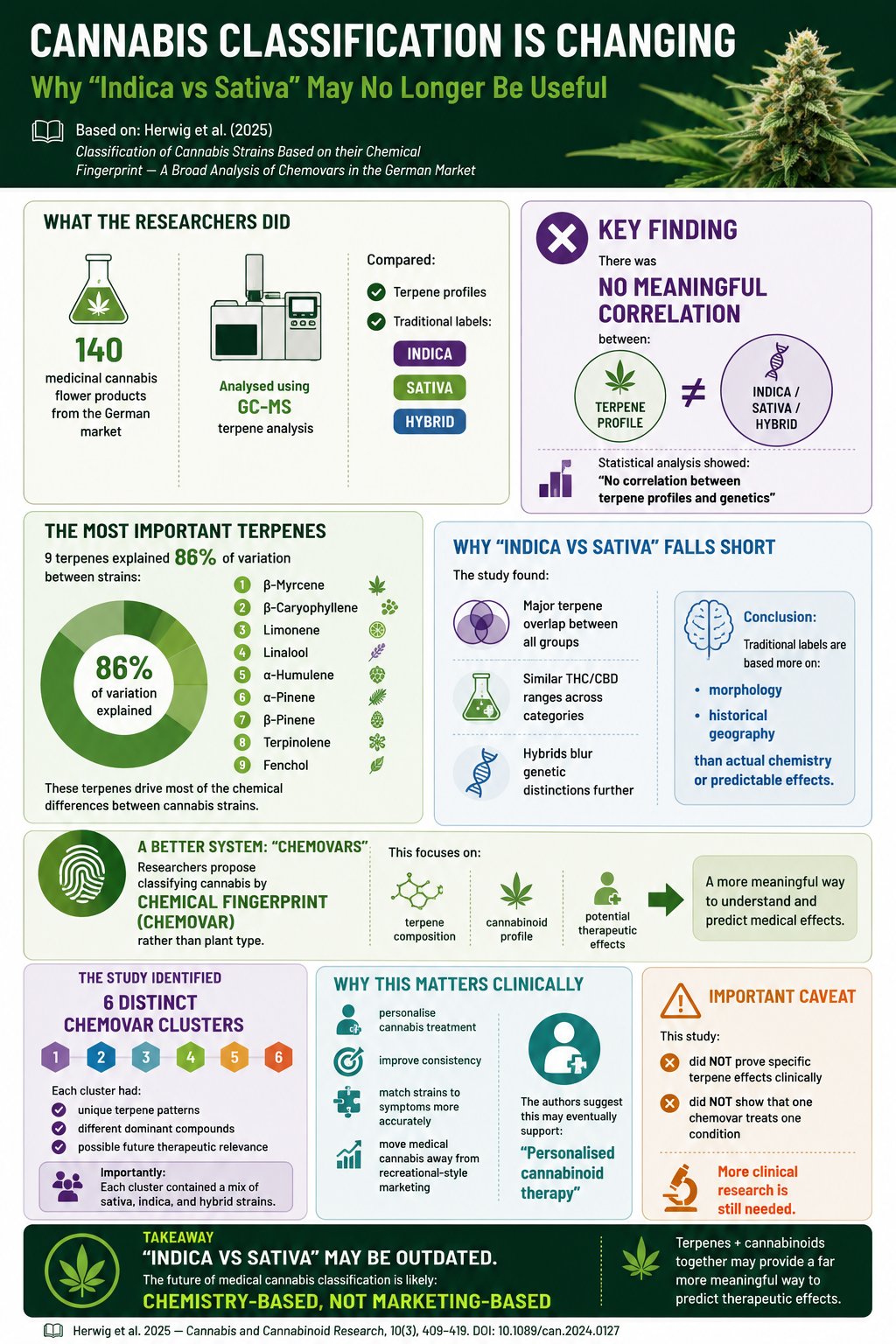
A 2025 study by Herwig et al., published in Cannabis and Cannabinoid Research, analysed 140 medicinal cannabis flower products from the German market using GC-MS terpene analysis. The findings were clear: there was no meaningful correlation between terpene profiles and traditional Indica, Sativa, or Hybrid labels. Nine terpenes explained 86% of the chemical variation between strains, but these profiles did not map onto the genetic labels patients and clinicians commonly use.
The researchers proposed classifying cannabis by chemovar, grouping products by their chemical fingerprint rather than plant type. Six distinct chemovar clusters were identified, each with unique terpene patterns and dominant compounds. Importantly, each cluster contained a mix of Indica, Sativa, and Hybrid strains, which rather makes the point.
Why this matters in practice
Growing conditions, cultivation methods, curing, and harvest timing can significantly alter the profile of cannabinoids, terpenes, flavonoids, and volatile sulphur compounds in the final product. Think of it like taking cuttings from the same tomato plant (genetic clones) and growing one hydroponically under fantastic lighting, and the other in ordinary soil in the shade. The harvest would look different, the taste of the fruit would be different, and the quality would be different, despite coming from the same genetic source. Cannabis is no different. It is why the Gorilla Glue you tried in Amsterdam might taste and feel completely different to the same strain grown by your friend Dave in his attic. Two products sold under the same Indica label can have completely different terpene profiles and produce very different clinical effects.
Guiding patients using cannabinoid and terpene profiles is likely to be a far more meaningful approach to personalised cannabis medicine. If a patient consistently responds well to a product high in beta-caryophyllene and linalool, that is clinically useful information. Knowing it was labelled Indica is not.
The traditional labels are not entirely without value as a rough guide, particularly for patients who have built up experience with specific products. But the direction of travel is clear: chemistry-based classification, not marketing-based classification.
Acknowledgement
This piece grew out of a conversation with Alexander Mountain of Trichome Solutions, which proved both informative and genuinely enlightening. His knowledge of cannabis cultivation and phytochemistry shaped much of the thinking here and is well worth seeking out if you work in this space.
Reference
Herwig et al. 2025. Cannabis and Cannabinoid Research, 10(3), 409-419. DOI: 10.1089/can.2024.0127
Comments & discussion
I welcome discussion on everything I write here. Medicine is rarely black and white, and botanical medicine shows even greater variance than most fields. I am genuinely open to other opinions and perspectives, and I read every comment.
Comments are approved before they appear, so there may be a short delay. Frank discussion of drugs, drug use, and differing clinical views is welcome. Hateful or abusive comments are not.